
Only 6% of all home sales happen without a realtor. This tiny percentage tells quite a story.
Selling your home without professional help could cost you big – about 13% less than agent-assisted sales. On a median-priced home, that’s $55,000 less in your pocket. Real estate agents take 5-6% of the final sale price as commission, and many homeowners struggle with this cost-benefit equation.
We get why you’re torn. The numbers might not look great, but selling without a realtor can make sense in some cases. A cash buyer could close the deal in just a week if you need to sell fast.
Eight out of ten sellers who tried the for-sale-by-owner path wished they’d done things differently. But don’t let that discourage you. The right preparation and knowledge can help you direct this process well.
This piece will show you everything about selling without a realtor. You’ll learn the good and bad sides, other options you have, and get a detailed plan to sell your house. Our goal is to help you maximize profits and keep stress levels low.
Should You Sell Without a Realtor?
The choice to sell your home without a professional agent can impact both your finances and peace of mind. Let’s get into what you should know about this approach before you put up that “For Sale By Owner” sign.
When it makes sense to go FSBO
You might want to sell without a realtor (known as FSBO or “fizbo”) in these situations:
You already know your buyer. The National Association of Realtors reports that 57% of FSBO sellers had prior connections with their buyers. This connection makes negotiations easier and speeds things up.
The market is red hot with buyers outnumbering available homes. These conditions often lead to offers matching or going above the listing price.
Your background includes real estate experience. A survey of successful FSBO sellers shows many had worked as agents or knew their way around paperwork, pricing, and negotiations.
Rural areas seem to favor this approach. Data shows 12% of homes sold this way in rural regions compared to 4% in cities. The rural market dynamics make independent selling a viable option.
This path might suit you if you want to control every part of the sale and have time to handle it right.
Common misconceptions about agent commissions
People often choose FSBO to avoid paying commission fees. Here’s what they get wrong:
Misconception 1: Buyer representation is free for buyers Sellers usually cover both agents’ commissions, but this isn’t set in stone. Buyers must pay their realtor if sellers don’t offer to cover the buyer’s agent commission.
Misconception 2: Commission rates are fixed Market forces determine these rates, which can be negotiated. The national average has dropped from 6.1% in the 1990s to 5.4% in 2023.
Misconception 3: You’ll save the entire commission Most FSBO sellers still pay the buyer’s agent commission (2.5-3%) to attract more buyers. NAR data shows 77% of sellers offer this commission.
Misconception 4: Realtors get paid regardless of outcome Agents only earn money when a sale closes. They put in time and resources upfront without any payment guarantee.
Pros and cons of selling a house without a realtor
Pros:
- Potential cost savings: You won’t pay the listing agent’s commission (usually 2.82%), but expect to pay the buyer’s agent.
- Complete control: The sale process stays in your hands, from pricing to closing.
- Personal knowledge advantage: You know your neighborhood’s ins and outs that buyers love to hear.
- Full dedication: The sale gets your undivided attention, unlike agents who handle multiple properties.
Cons:
- Lower selling price: The numbers tell the story. FSBO homes sold for $310,000 (median) in 2023, while agent-listed homes reached $405,000.
- Legal risks: A survey revealed 36% of FSBO sellers made legal mistakes without an agent’s guidance.
- Buyer distrust: About 43% of sellers faced skepticism from buyers due to lack of representation.
- Contract confusion: The paperwork stumped 40% of FSBO sellers.
- Limited marketing: Your home gets less exposure without MLS access and professional marketing.
- Emotional challenges: The process took its toll – half the FSBO sellers cried during the sale, and 52% felt overwhelmed.
The upfront savings look tempting, but the numbers paint a different picture. Agent-assisted sales bring in $46,603 more profit on average than FSBO sales. FSBO sellers are also three times more likely to lose money on their sale.
Explore Your Selling Options
You have options when you decide to sell without a real estate agent. Let’s look at several ways to move forward, each with its own benefits based on what you need and want to achieve.
Sell to a cash buyer
Cash buyers make the home selling process quick and simple. They buy properties directly without mortgage financing and can close deals in just 1-2 weeks. The market has several types of cash buyers:
- iBuyers like Opendoor and Offerpad work in select markets and make quick offers on homes that are in decent condition and meet their criteria
- House flippers buy homes to fix up and resell at a profit, and they’ll often take properties in any condition
- Trade-in companies give cash offers (usually a percentage of home value) so you can make all-cash offers on your next home
- Cash-buying franchises usually pay 50-70% of market value but take properties in poor condition
Speed and simplicity are the biggest advantages here. You won’t deal with financing contingencies, and inspection negotiations are minimal or non-existent. On top of that, cash buyers usually take homes “as is,” so you can skip cleaning, staging, or repairs. This works great if you need to sell quickly because of a move, divorce, or money problems.
Call us today for a free no-obligation cash offer if you want to learn more about this easy option.
In spite of that, you’ll get less than market value for this convenience – cash investors usually offer 60-80% of fair market value.
Use a real estate attorney
A real estate attorney might be your best choice if you already have a buyer ready – maybe a friend, family member, tenant, or neighbor.
A real estate attorney can:
- Draw up and review sales contracts and purchase agreements
- Handle title searches and ensure clear property transfer
- Prepare disclosures and other legal documents
- Oversee closing to ensure proper completion
- Solve the problems of boundary disputes or unresolved title matters
Attorneys charge flat fees or hourly rates, unlike agents who work on commission. Some states have real estate attorney fees between $217-$384 per hour. Many lawyers charge flat fees from $800-$1,200 per deal, depending on how complex it is.
Legal help can be a great way to get guidance about complex paperwork requirements, even if your state doesn’t require an attorney. Lawyers also represent your interests without having a stake in your sale price, unlike agents.
Go full FSBO (For Sale By Owner)
The DIY route helps you avoid paying any agent commissions. FSBO means you’ll handle everything: pricing, marketing, showings, offer negotiations, and closing coordination.
This path works best if you:
- Know your way around real estate
- Have time to dedicate to the process
- Are selling when buyers outnumber sellers
- Have someone interested in buying already
The commission savings look attractive, but FSBO comes with its share of hurdles. Zillow reports that all but one of these sellers eventually need an agent’s help. Limited exposure and lack of experience cause most of these struggles.
Your listing won’t show up on major real estate websites without MLS access, which cuts down your visibility by a lot. You can still list on Zillow, Trulia, FSBO.com, HomeFinder, and forsalebyowner.com. Some listings are free, while others cost money.
Most FSBO sellers still pay buyer’s agent commissions (usually 2.5-3%) to attract more buyers and stay competitive, even though they skip the listing agent fees. You’ll also need to handle everything from paperwork to showings to negotiations – tasks that need time, knowledge, and patience.
Your choice between these options comes down to balancing time, money, convenience, and final sale price. The right path depends on your situation, timeline, and how comfortable you feel with the selling process.
Steps to Selling a House Without a Realtor
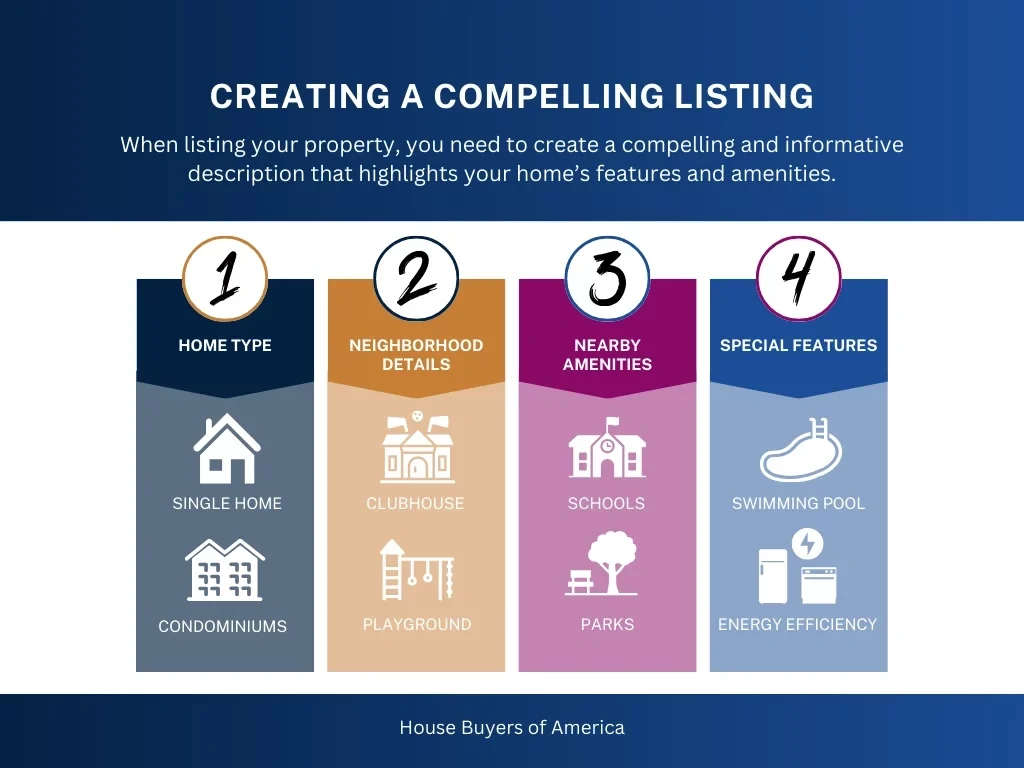
Image Source: House Buyers of America
Want to sell your house without a realtor? You’ll need to master a few key steps in the home selling process. Let me show you how to sell your house on your own.
1. Research your home’s market value
Your home’s accurate value sets the foundation for a successful sale. Start with online tools like Zillow or HomeLight’s estimator to get a rough idea. Remember these automated tools just give you a starting point. They might miss recent upgrades or specific location details.
You’ll get better results with a comparative market analysis (CMA). Look at recent sales of properties in your area that match yours in:
- Size and square footage
- Number of bedrooms and bathrooms
- Age and condition
- Neighborhood and location
- Special features or amenities
A professional appraiser can give you an unbiased view of your home’s value. It costs between $300-$600 but helps avoid pricing mistakes.
2. Set a competitive listing price
Now that you’ve done your research, it’s time to pick your asking price. Most sellers make the mistake of overpricing their homes. This often keeps the house on the market longer.
A good pricing strategy looks at:
- Your market analysis and appraisal results
- Current market conditions (buyer’s vs. seller’s market)
- Your profit after selling expenses
- Space for negotiations
- Online search bracket optimization (buyers search in specific price ranges)
Most buyers shop for homes online. You might want to adjust your price slightly (like $299,900 instead of $300,000) to show up in more searches.
3. Prepare your home for sale
First impressions can make or break a sale. Give your property a deep clean. Remove personal items like family photos so buyers can picture themselves living there.
Fix small issues like leaky faucets or cracked tiles before listing. Make the outside look great with simple landscaping: mow the lawn, trim bushes, and add fresh mulch or flowers.
Keep in mind – make your home look its best without spending too much on improvements.
4. Hire a professional photographer
Don’t skip professional photos. Homes with professional pictures sell for $3,400-$11,200 more than those without. Since 95% of buyers start their search online, great photos matter.
Professional real estate photographers charge $150-$500 depending on your home’s size. They use wide-angle lenses and proper lighting to make rooms look spacious and welcoming.
5. List your home on the MLS
The Multiple Listing Service (MLS) gets your home maximum exposure. Only licensed agents can post directly to MLS, but you can use a flat-fee MLS service. These services cost $100-$500 for basic packages.
Your home gets listed on the local MLS and appears on popular sites like Zillow, Realtor.com, and Redfin. You’ll need:
- Detailed property information
- Professional photos
- Property descriptions
- Disclosures about lead paint and other conditions
- Your priorities for showings and commissions
6. Market your property effectively
Go beyond MLS with a multi-channel marketing approach. Put up a yard sign with your contact details, hand out flyers, and share your listing on social media and local community pages.
Weekend open houses attract more buyers. Today’s market demands virtual tours – they keep potential buyers interested and show off your entire property.
More exposure usually means more offers, which can lead to a higher sale price.
Handling Inquiries and Showings
Image Source: ForSaleByOwner
Your listing will attract attention, and you’ll need a good system to handle all the buyer interactions. Being organized and quick to respond is key to selling a house without a realtor.
Responding to buyer questions
Buyers come with many questions, so good preparation makes all the difference. You should be ready to answer common questions about:
- Roof age and condition
- Age of major systems (furnace, air conditioning, water heater)
- Property boundaries and lot lines
- HOA information and fees
- Basement condition and potential leakage
- Neighborhood characteristics
- Typical utility expenses
Stay professional in your answers but avoid the question “Why are you selling?” because it might hurt your bargaining power. As an FSBO seller, you’re both the owner and salesperson—saying “I’ll get back to you” won’t build trust.
Scheduling and managing tours
Buyers love quick responses to their showing requests. Set up a well-laid-out showing schedule during daylight hours to show your home at its best. Keep initial visits between 30-45 minutes with clear start and end times. This helps maintain momentum while you sell.
Safety comes first – never show your house alone. Having someone else there helps with security and makes it easier to manage multiple visitors.
Get contact details from everyone who views your property for future communication. You might want to host weekend open houses with private showings the next week. Most buyers like to see a property twice before they make an offer.
Screen potential visitors by asking about their timeline, financial readiness, and what they’re looking for in a property. This helps attract serious buyers.
Following up with potential buyers
Start your follow-up right away—even while buyers are still at your open house. Put contact sheets next to refreshments. This creates a natural way to collect information before people leave.
After each showing, reach out to visitors to learn what they liked and what might make the home more appealing to them. This helps you get valuable feedback and keeps the conversation going.
The “8×8” schedule works well for ongoing follow-up—contact prospects once a week for eight weeks straight. This steadfast dedication often pays off because many agents give up too soon.
Make yourself stand out by sending short, personal video messages that address specific questions about your property. This shows buyers you’re committed to helping them.
Negotiating and Managing Offers
A house sale without a realtor reaches a vital turning point when you receive an offer. This stage needs careful analysis and smart thinking to protect your interests and get the best price.
Reviewing offers and contingencies
The price tag isn’t everything when you evaluate offers. In fact, the highest offer might not be the strongest one. Let’s get into these important elements:
- Financing verification: Cash offers typically close faster with fewer risks
- Earnest money: Larger deposits (2-5%) signal serious buyers
- Contingencies: Each adds potential exit points for buyers
- Closing timeline: How well it fits your needs
- Buyer’s financial stability: Down payment percentage and loan type
Contingencies give buyers the right to back out if specific conditions aren’t met. The most common ones include financing, appraisal, inspection, and home sale contingencies. Note that too many contingencies can make an offer less attractive, and this affects your timeline.
How to negotiate without an agent
You need flexibility and clear priorities to negotiate successfully without a realtor. Set your bottom line and know what you’ll compromise on before you start talking terms.
A real estate attorney can provide great protection during negotiations, especially when you have contractual elements that seem complex. Their professional guidance helps you avoid getting pricey mistakes.
The process needs a cool head and objectivity. About 36% of FSBO sellers admit making legal mistakes during negotiations. Your confidence and deep understanding of your property’s value will serve as your best tools.
Handling counteroffers and timelines
You create a counteroffer by responding to buyers with modified terms—usually changing price, contingencies, or closing dates. The original offer becomes void after you counter, which creates a new agreement.
Buyers usually include expiration times in their offers. You should respond within 24-48 hours to keep their interest alive. Buyers might look at other properties if you take too long.
With multiple offers on the table, asking for “highest and best” makes buyers show their strongest terms upfront. This strategy eliminates weaker offers without revealing details about competing bids.
A title company or attorney should help you document all changes and finalize the accepted terms.
Paperwork and Legal Requirements
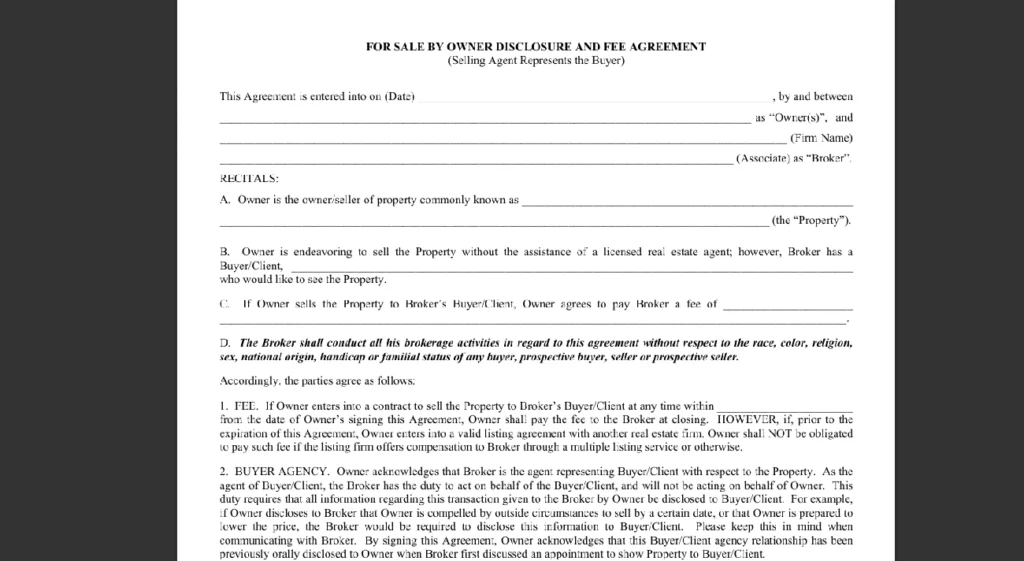
Image Source: WPS Office
Selling a house without a realtor requires significant paperwork that can overwhelm you if you don’t have proper guidance. You need to understand your legal obligations early to avoid getting pricey mistakes and protect your interests.
Required documents and disclosures
You’ll need several important documents to sell your home:
- Property deed and title report
- Seller disclosure forms (material defects, hazards)
- Lead-based paint disclosure (mandatory for pre-1978 homes)
- Purchase agreement and bill of sale
- HOA documents (if applicable)
- Property survey, permits, and building plans
- Loan payoff statement
- Recent utility and property tax bills
State laws require detailed property disclosures. To cite an instance, California requires a Transfer Disclosure Statement (TDS) that covers everything from structural issues to neighborhood nuisances.
Working with a real estate attorney
A real estate attorney provides critical protection even if you’re selling independently. A skilled attorney will:
- Draft or review legally binding contracts
- Ensure compliance with state-specific disclosure laws
- Handle title searches to identify potential issues
- Manage escrow accounts and fund disbursement
- Prepare closing documents
Attorney fees range from $500-$1,500 based on how complex the transaction is.
Avoiding legal mistakes in FSBO sales
The most common legal pitfalls include:
- Inadequate property disclosures (36% of FSBO sellers make disclosure errors)
- Using generic online contracts that lack state-specific language
- Mishandling earnest money deposits
- Missing critical deadlines in contracts
Selling a house without a realtor checklist
Here’s how to organize your documents by stage:
- Before listing: deed, title report, disclosure forms
- During contract: inspection reports, repair records, appraisal
- At closing: closing statement, deed transfer, title insurance
Conclusion
Selling your house without a realtor brings both challenges and opportunities to homeowners who want to maximize their profits. Statistics show FSBO homes sell for less than agent-assisted properties, but good preparation and knowledge can help you beat these odds. Your specific situation, timeline, and comfort level with the real estate process should drive this decision.
The right information helps you decide if FSBO fits your needs. Cash buyers give you speed and convenience but at a lower profit. Real estate attorneys offer legal protection without the high commission costs. A complete FSBO approach puts you in control but needs your time and market expertise.
Your success largely depends on solid preparation. Market research leads to accurate pricing, while professional photos and strong marketing boost your home’s appeal. Good negotiation skills help you get the best deal. The right handling of paperwork and legal requirements keeps you safe from expensive mistakes.
FSBO works best when you have a buyer ready, know the real estate market, or see very favorable conditions. The money you save might not be worth the risks and challenges in other situations.
This piece gives you practical knowledge and useful steps to help you sell your home on your own. Research and careful planning are your best tools for a successful sale, whatever path you take. Your home is a major investment, and you should make smart choices about how to sell it.

Key Takeaways
Selling your house without a realtor can save commission fees but requires careful consideration of the trade-offs between cost savings and potential risks.
• FSBO works best in specific situations: When you already know your buyer, have real estate experience, or are selling in a hot market with high demand.
• Expect lower sale prices despite commission savings: FSBO homes typically sell for 13% less than agent-assisted sales, often negating the 5-6% commission savings.
• Professional pricing and photography are non-negotiable: Accurate market research and quality photos can increase your sale price by $3,400-$11,200 and attract serious buyers.
• Legal protection is essential: Hire a real estate attorney ($500-$1,500) to handle contracts and disclosures, as 36% of FSBO sellers make costly legal mistakes.
• Consider cash buyers for speed over maximum profit: Cash sales close in 1-2 weeks at 60-80% of market value, ideal for urgent situations like divorce or relocation.
While only 6% of home sales are FSBO, success is possible with proper preparation, realistic expectations, and professional support where needed. The key is matching your selling method to your specific circumstances, timeline, and risk tolerance.
FAQs
Q1. Is selling a house without a realtor financially beneficial? While you can save on realtor commissions, FSBO homes typically sell for about 13% less than agent-assisted sales. The potential savings may be offset by a lower final sale price, so carefully weigh the pros and cons for your specific situation.
Q2. What are the main challenges of selling a house without a realtor? The main challenges include accurately pricing your home, effectively marketing the property, handling inquiries and showings, negotiating offers, and navigating complex paperwork and legal requirements. It can be time-consuming and may require significant research and preparation.
Q3. How can I market my FSBO property effectively? To market your FSBO property effectively, list it on the MLS through a flat-fee service, use professional photography, create compelling property descriptions, utilize social media and online platforms, host open houses, and consider offering a buyer’s agent commission to attract more potential buyers.
Q4. What legal considerations should I be aware of when selling FSBO? Key legal considerations include understanding and preparing necessary disclosure forms, drafting a legally binding purchase agreement, handling earnest money deposits correctly, and ensuring compliance with state-specific real estate laws. It’s advisable to work with a real estate attorney to avoid potential legal pitfalls.
Q5. How do I handle negotiations and offers without a realtor? To handle negotiations and offers, research comparable sales to understand your home’s value, set clear priorities and a bottom-line price, remain objective, and consider hiring a real estate attorney for guidance. Be prepared to review and respond to offers promptly, and understand the implications of various contingencies and terms.